
Knowing your minimum viable budget can change how you think about your monthly spending.
Whether you’re facing financial uncertainty or simply want more control over your money, calculating your survival budget can give you a clear picture of what you actually need each month, and a plan for handling whatever comes next.
What is a Minimum Viable Budget?
A minimum viable budget is a stripped-down version of your regular budget that covers only the expenses you need to get through the month. Think of it as your worst-case-scenario budget.
Knowing this number tells you the minimum amount of income you need to cover your essential expenses for one month. And that can provide some peace of mind. Knowing you could live on less may reduce some of the fear that comes with potentially losing income.
Your minimum viable budget can also help you decide how much to keep in your emergency fund. Six months of essential expenses is a common benchmark, so you could multiply your minimum viable budget by six to come up with an emergency fund goal. Of course, everyone’s situation is different, and your ideal emergency fund may be higher or lower.
It can also change how you think about your everyday spending.
For example, if you bring home $4,000 a month but your minimum viable budget is $2,500, there’s a $1,500 difference between what you earn and what you truly need to get by. If you’re struggling to save right now, seeing that gap can help you identify where you might be able to cut back and put more toward your goals.
Step 1: Identify Your Non-Negotiable Expenses
Start by going through your transactions or current budget and identifying your non-negotiable expenses. These are the things you truly need to keep a roof over your head, the lights on, and food on the table.
When I do this exercise, I think about the items I would still spend money on, even if I didn’t have a job.
This typically includes items such as:
- Rent or mortgage
- Groceries
- Household bills, such as utilities
- Cell phone bill
- Transportation costs
- Insurance payments
- Minimum debt payments
- Minimal entertainment costs, such as one streaming platform
Of course, your list will be unique to you.
In my example, I included one streaming platform since if I’m going to be home all the time and not working, I’m going to need something to do. Someone else might consider that an unnecessary expense and cut it completely.
Expenses that wouldn’t typically make it into a minimum viable budget include:
- Savings
- Extra debt payments
- Vacations
- Restaurants
- Shopping
List every bill and spending category you want to include. Remember, this isn’t supposed to be a long-term budget. It’s the budget you could fall back on during an emergency and realistically live with for a few months if you had to.
Step 2: Add a Buffer
There’s no such thing as a perfect month, and even a bare-bones budget needs a little breathing room.
A buffer is simply some additional money built into your budget to cover small surprises. Add it as its own line item rather than assuming every month will go exactly according to plan.
How much you include is up to you. If you aren’t sure where to start, try 10% of your minimum viable budget. If that feels like too much or too little, adjust it to fit your situation.
Keep in mind that a buffer and an emergency fund serve different purposes.
Your buffer is there for smaller, everyday surprises, such as a jump in gas prices or a bill you forgot to include in your budget. Your emergency fund is for bigger financial emergencies, such as losing your job or dealing with a major car repair.
Your buffer can stay in your checking account where it’s easy to access, while your emergency fund can sit in a high-yield savings account where it has the opportunity to earn interest.
Step 3: Calculate Your Minimum Monthly Number
Now, add up everything in your minimum viable budget, including your buffer. That total is your minimum monthly number, or the amount you would need to earn or withdraw from savings to cover one month of essential expenses.
You can also use this number to set an emergency fund goal.
Remember, multiplying your minimum viable budget by six gives you six months of essential expenses. But six months doesn’t have to be the right number for everyone.
If layoffs are a concern or you work in an industry where finding a new job can take a long time, you may feel more comfortable with a larger emergency fund, potentially up to a year of expenses.
On the other hand, if you have multiple reliable income streams and it’s unlikely your household income would fall to zero, three months of expenses may feel like enough.
The goal is to build an emergency fund that reflects your actual expenses and the amount of financial uncertainty you’re comfortable with.
Step 4: Track Your Budget In Lunch Money
Lunch Money allows you to categorize and track all of your expenses. This allows you to verify your minimum viable budget is correct and track how it changes over time.
There are a few ways you could set up Lunch Money to do this.
First, you could use a category group to group all of your minimum viable budget categories together. For example:
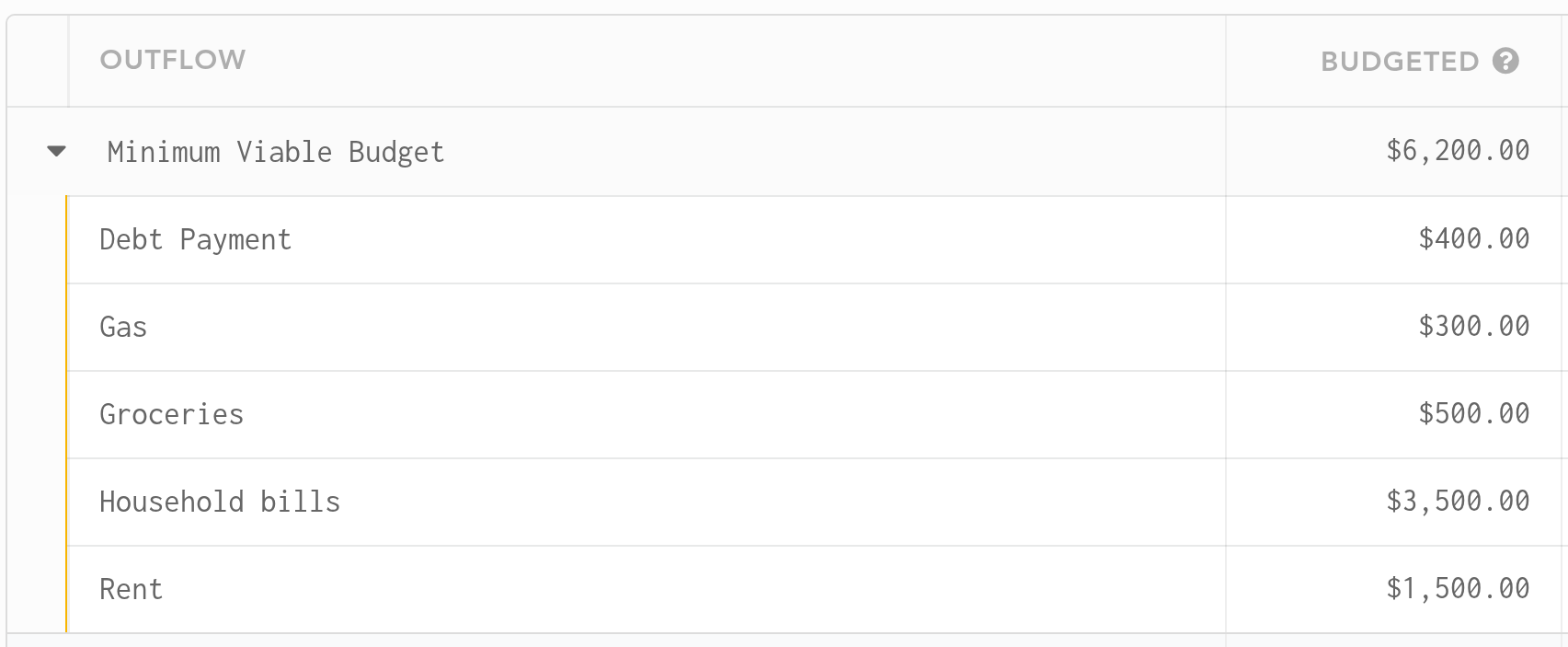
This allows you to see what your total minimum viable budget is and how it breaks down into specific expenses.
If you don’t want to create a category group, you could use tags instead. You can set up your budget in a way that makes the most sense to you, and then add a tag to any expense you want to include in your minimum viable budget. For example,
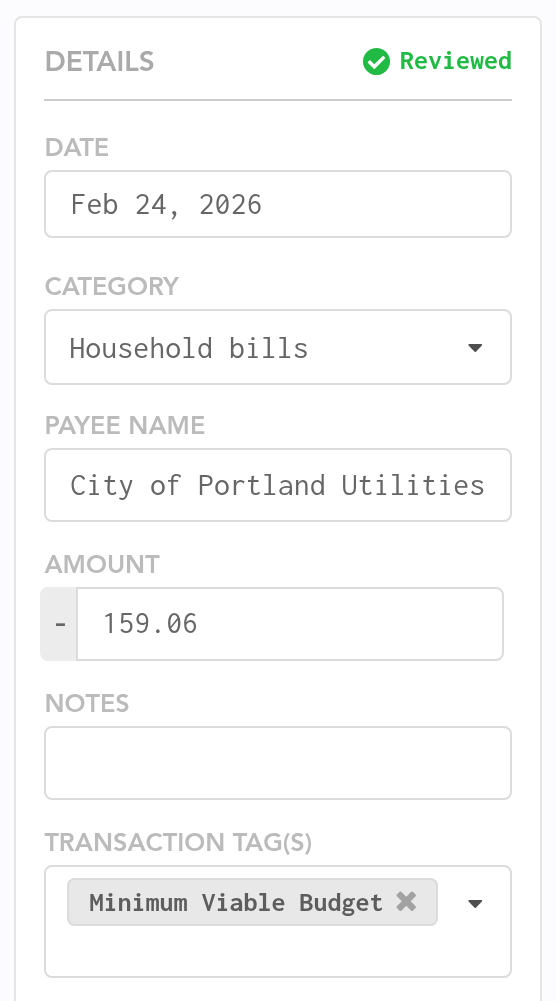
You can then pull reports showing all transactions with the Minimum Viable Budget tag and see the total over a set period.
Summary
Calculating your minimum viable budget can give you peace of mind by showing you exactly how much money you need to cover your essentials each month.
It can also give you a new perspective on your regular spending. If there’s a large gap between your normal budget and your minimum viable budget, you’ll have a clearer picture of which expenses are essential and which ones you could reduce if your financial situation changed.
Tracking those expenses in Lunch Money can help you verify that your minimum viable budget is realistic and keep it updated as your expenses change.
You may never need to live on your survival budget. But knowing that you could can make a difficult situation feel a lot more manageable.