
You know that feeling you get when the holidays are around the corner — you suddenly find yourself running through the list of everyone you need to buy gifts for, and your anxiety shoots through the roof.
But what if you could take money off the list of worries? After all, holidays, birthdays, and other celebrations are so much more enjoyable when you’ve budgeted for gifts.
Here’s the good news! With a bit of planning, you can keep your spending under control and avoid the last-minute panic.
9 Ways to budget for gifts
1. Create a sinking fund
A sinking fund is just an account used to save for periodic expenses that don’t come up every month (like presents!).
Starting a sinking fund for gifts is easy. First, estimate how much you spend on birthdays, holidays, weddings, baby showers, etc., over a full year. Then, add it all up and divide by 12 — that’s how much you should set aside each month.
When it’s time to buy a gift, simply transfer the money from your sinking fund and make the purchase.
2. Have one general gift fund
Instead of juggling separate budgets for multiple occasions (e.g., weddings, holidays, birthdays), keep things simple by opening a dedicated savings account just for gifts.
You can also set up an automatic transfer to move money into your gift fund for future celebrations.
3. Set spending limits
It’s tempting to overspend on gifts throughout the year, especially if you have kids! That’s why it’s so important to create a clear budget and stick to it — for example, you might choose to set an annual $200 limit for birthday presents.
For the holidays, look at what’s in your sinking fund and set a total gift budget. Then make a list of everyone you want to buy for and divide that amount across your list.
Do you struggle with impulse spending? Try the envelope budgeting method and use cash only. That way, you can’t physically spend more than the amount you placed into each envelope.
4. Look for items on sale
If you want to stretch your budget further, shop sales throughout the year to get the best price.
But what if you budgeted $50 for someone’s gift, then found it on sale for $35? What should you do with the leftover $15?
According to a Reddit discussion on r/budget, you don’t have to max out your spending limit.
“It’s OK to spend less than what you budgeted for,” said u/rastab1023. “It’s also OK to transfer that savings onto another gift.”
So, you could use that $15 toward someone else’s gift or move it back to your general budget.

5. Buy generic brands
When looking for tips on how to budget for gifts, consider generic over name brands. Depending on the item, most people only care about the usefulness of the gift, making this is an easy budgeting hack.
For example, instead of gifting a $35 Yankee Candle, you could buy a similar one for around $10.
If you want to make it more special, add a handwritten note and wrap it nicely — the gesture will feel just as meaningful.
6. Buy gifts strategically
We mentioned earlier that you should look for deals early. The best way to do that is to shop throughout the year.
If you already have a gift in mind, you can be strategic about when you buy it. Chances are, you’ll find the lowest prices on major shopping days, such as Amazon Prime Day, Black Friday, or Boxing Day.
You can also snag some great deals at end-of-season clearance sales, so keep your eyes open for hot finds after the holidays.
7. Keep a gift closet
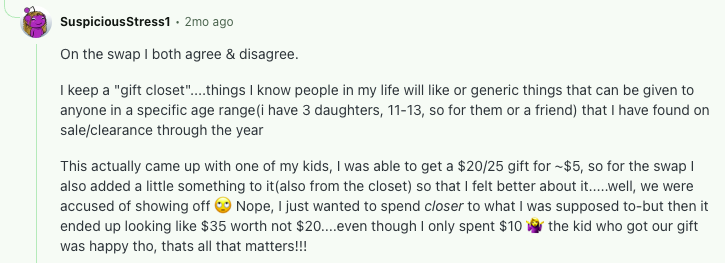
This idea was inspired by Reddit user u/SuspiciousStress1:
“I keep a ‘gift closet’… things I know people in my life will like or generic things that can be given to anyone in a specific age range (I have three daughters, 11-13, so for them or a friend) that I have found on sale/clearance through the year.”
With a gift closet, you have a designated space to store the deals you find throughout the year. You also have a stash of presents if you need a last-minute gift for a party.
8. Add a buffer to your gift budget
Always build a little buffer into your sinking fund to prepare for the unexpected. Let’s say your friend buys a new house, or you receive a last-minute invite to a wedding. By adding 5% to 10% to your gift budget, you can account for surprises so they don’t throw off your budget.
If you don’t end up needing that money, you can simply leave it in your gift fund or roll it over for other expenses.
9. Don’t forget about DIY gifts
They say it’s the thought that counts. What is more thoughtful than a homemade gift?
DIY Christmas gifts can save you a ton of money since they often only require simple, inexpensive materials. Think hand-painted ornaments, decorated mason jars, or baked goods.
These presents feel extra meaningful because of the time and care you’ve put into creating them, all while helping you live within your means.
What should you do with leftover gift money?
If you end up with under-budget money in your gift fund, congrats, you spent less than you planned!
You have a few options: roll that money over for next year’s gifts, move it to another savings account, or even treat yourself.
Lunch Money’s rollover budget feature makes this simple. You can roll the balance into the same category, move it to your general budget, or reset it to zero.
How Lunch Money can help you budget for gifts
If you’re wondering how to budget for gifts, Lunch Money makes it super simple. Just create a dedicated “Gifts” budget category and treat it like a sinking fund. For example, you might set aside $50 or $100 of your monthly income.
Over time, that money adds up, so when the holidays, birthdays, or other celebrations roll around, you have the funds ready to go.
That way, you don’t have to scramble to figure out how you’re going to pay for gifts. You’ve already planned, and Lunch Money makes it easy to see how much you’ve set aside.
Summary
Holidays and birthdays shouldn’t be stressful. When you know how to budget for gifts, you experience the joy of giving instead of worrying about how to pay for them.
Simple strategies, like starting a sinking fund to save money for Christmas, buying generic gifts, and making DIY presents, are just a few ways to relieve some of the financial stress.
And Lunch Money is here to help! Sign up for a free 30-day trial today to see how stress-free gift giving can be.