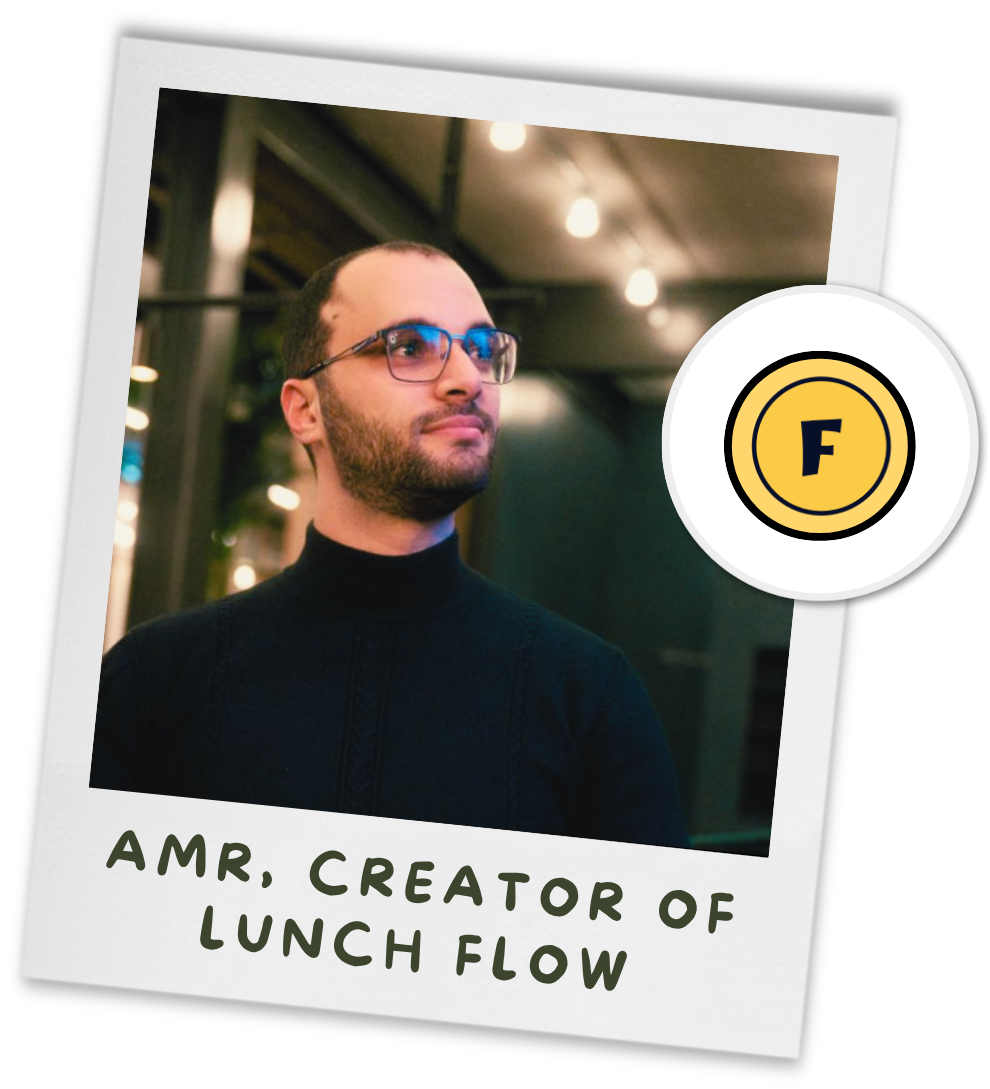
In December 2024, we interviewed Amr, the developer behind Lunch Flow, a tool to help Lunch Money users in the UK and Europe import transactions from banks that Plaid does not support.
At the time, Amr was already thinking about where the project might go next. Less than two years later, Lunch Flow supports thousands of users well beyond the UK and Europe, and Amr has left his day job to work on the business full-time. We caught up with him to learn what it took to build while working another job, how Lunch Flow evolved, and how he decided it was time to make the leap.
In this month’s spotlight we’re catching up with Amr and Lunch Flow
🧭 From side project to full-time career
Q: You built and supported Lunch Flow while still working full-time. How did you balance the project with your job, family, and life outside work?
I’ll be honest, it wasn’t sustainable or consistent. Sometimes I worked 14- to 16-hour days, which wasn’t great for my family or my health. There were times when I needed to step back from the project for a few weeks to catch up.
Establishing clear priorities helped. I made sure that family commitments came first whenever something urgent came up. I also needed to prioritize ruthlessly. There will always be more work to do, so when your time is limited, you have to decide which are the highest-leverage things to work on.
Q: Looking back, was there a specific moment where Lunch Flow stopped feeling like a side project and started feeling like a real business?
Oddly enough, it was the first Stripe subscription — thanks, Kate! That was the first money I had earned online from a product, not a service, and that made it feel real. Every milestone since has felt special because I’ve never taken any of it for granted. I even wrote a Medium article (my first ever) to celebrate reaching 18 paid subscriptions in the first two and a half months.
Q: What ultimately gave you the confidence to leave your job and focus on Lunch Money full-time?
I recently went through an accelerator in London while still working my full-time job. I used to think that to build your own company, you had to have everything figured out in advance. But listening to experienced founders say, “Sometimes we have no idea what we’re doing,” was a big unlock for me.
I learned that you can control the effort that you put in, but not the outcome. This was critical, as working on Lunch Flow part-time showed me what goes into building a company beyond the product itself. Trying to control every outcome would have been an easy path to burnout, so accepting that uncertainty has relieved some of the anxiety.
Lastly, the traction we had already built also gave me confidence. People found out how many paying users we had and heard the testimonials our customers were kind enough to share, and their reactions helped me realize how special that was! It’s not something I take for granted.
🌱 How Lunch Flow Evolved
Q: When we first spoke, Lunch Flow was only 12 weeks old. What feels most different today?
The biggest change for me is how much the vision has grown. Lunch Flow began as a companion app that allowed me and other users to connect European bank accounts to Lunch Money. As more people started using it, I realized the problem was much broader than I initially thought.
I set up a feedback board, partly inspired by Lunch Money’s, and people began asking for more geographic coverage and additional integrations. Today, over 35% of our users are outside the UK and Europe. Having more conversations with our customers made me realize how many people want more flexibility in connecting their financial data to the tools they use, which is what led me to develop our new platform API.
Q: How did Lunch Money — or the Lunch Money community — help you turn that initial idea into a working product?
Lunch Money has been instrumental in Lunch Flow’s journey. It inspired me to build the first version so I could connect my own accounts and get the multi-currency budgeting experience I had been looking for. From there, the Lunch Money team and community supported me with their time, feedback, and subscriptions as I continued to build and improve it.
When I started Lunch Flow, I had no idea it would grow into what it is today. But the Lunch Money team and community helped me see its potential.
Q: We’d love to hear about some of the milestone moments along the way. Which ones stand out most?
A few milestones stand out:
- Receiving my first testimonial: Knowing that someone liked Lunch Flow enough to recommend it to others meant a lot to me. (If you’d like to make my day, you can leave a review here! :))
- Hosting our first conference booth: A couple of months ago, I attended Muslim Tech Fest in London, a conference with over 2,000 visitors. Spending the entire day talking about my own project rather than someone else’s was indescribable.
- Going full-time: I still can’t quite believe it, and I keep expecting a stand-up invitation to land in my inbox! It’s still early days, and I’ll admit that I move between excitement and anxiety. But the journey has already been immensely rewarding, and for me, it’s more about that than the end destination.
Q: As Lunch Flow grew, what did you have to learn beyond writing software?
I’ve learned a lot through the customer support process, and interacting with users has been one of the most enjoyable parts of the project so far.
In the beginning, I sometimes took it personally if a customer expressed frustration over a subpar product experience, even though, more often than not, the underlying problem stemmed from a data provider or financial institution.
Since then, I have learned to focus on what we can control (how we respond to users, how we manage their expectations, etc.). I’m still learning, but I always try to remember that there’s a person behind every support request.
I’ve also learned the importance of networking and community. Building something alone for an extended period can be lonely, and you often end up navigating challenges through trial and error, which isn’t ideal. The right networks and support systems can help accelerate that learning, introduce you to new ideas, and create opportunities you’d have otherwise not known existed.
I plan to be more intentional about building those relationships moving forward!
💡 Lessons for Other Builders
Q: What should developers know about turning a side project into something people will pay for?
I used to spend a lot of time thinking about the tech stack, tooling, and infrastructure. I took pride in having zero lint errors and being able to spin up dozens of version-controlled AWS services with one command.
After all, that’s a big part of what I was paid to do in my career. But I’ve come to realize that users don’t care about any of that. Their only question is whether you can solve their problem. The rest is just noise.
Q: What advice would you give to someone who has an idea for a tool to improve their Lunch Money experience but is struggling to take the first step?
Ask yourself, what version of this could I build and share in #🤩-show-and-tell today? It’s very easy to build these days, so don’t overthink the first version. The most important thing is to get real feedback from people who have the problem you’re trying to solve.
It’s normal to feel that you’re in over your head. As long as you’re making progress every day, it’ll work out :)
Thanks, Amr! We are thrilled that a project that started with the Lunch Money developer API has now become your full-time job! Thank you for contributing to the Lunch Money ecosystem, and we wish you continued success!
Follow Jen’s journey 👋
Competing with billion-dollar companies may not be the disadvantage it seems. In a recent post, Jen reflects on competing with giants and how being independent allows Lunch Money to focus on people, not just profits.
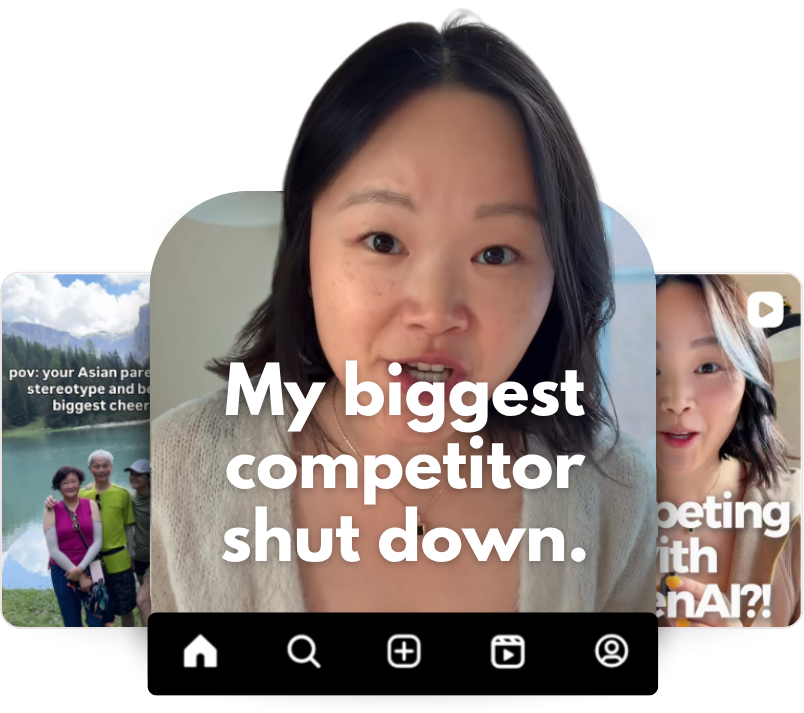
For more behind-the-scenes updates on everything from building Lunch Money to the bootstrapped founder lifestyle follow along on LinkedIn, TikTok, and Instagram.
Those who save together… 👯
Managing money is easier when you have the right tools, and even better when you can share those tools with the people around you. With Lunch Money for Organizations, teams, communities, clubs, and even your close-knit group of friends can get discounted access to Lunch Money starting at just $55 per person per year.

Give your group a simple way to get organized and feel more confident about their finances, without ads, upsells, or confusing financial jargon.
Call for community spotlight nominations 🗳️
Have a story you’d like to share with the community? It doesn’t have to involve building an app. We’d also love to hear how you use Lunch Money or how it’s made an impact in your life.
If you have a story you’d like to share, please fill out this quick form:
From the blog 📝
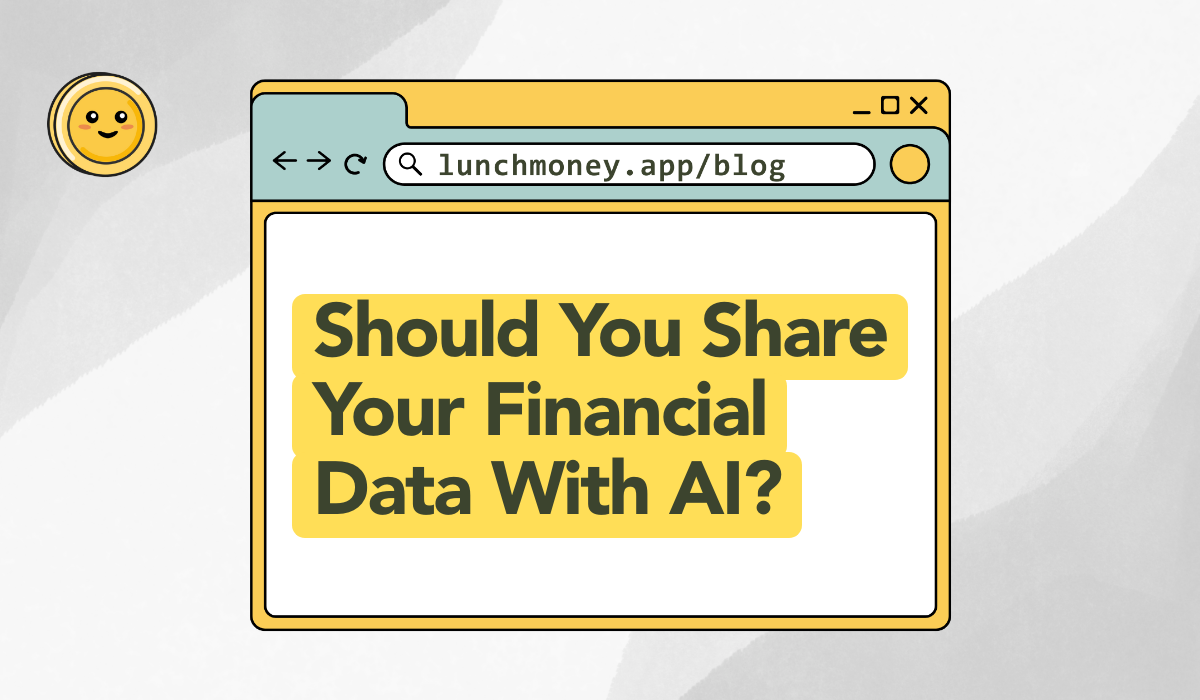
AI can help with all kinds of everyday tasks, from writing emails to planning meals. But with more and more people also using it for their personal finances, how do you know what information is safe to share?
Our latest blog post explains how to use AI alongside Lunch Money while keeping your sensitive financial data protected. 🛡️
Refer a friend, earn credit 💸️
Love using Lunch Money? Share it with a friend to grant them a 60-day trial, and earn 10% of their subscription cost as account credit every time they pay!
Connect with us on social media! 📱
We’d love to connect with you on social media. Find us on the following platforms: